Posts Tagged ‘growing power’

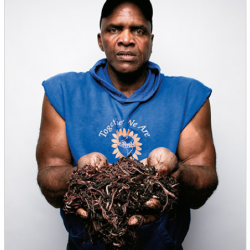
The Man is a Genius. (My Interview with Will Allen!)

February 7th, 2013

willby Sean Croxton

I admit it. I was super nervous about this interview.

It’s not often that I get to interview someone who has been awarded the MacArthur Foundation Genius Grant.

I remember the first time I ever heard of Will Allen. An old personal training client told me about all the good Will was doing in Milwaukee, providing access to real food in the inner city.

Maybe a year later, I reviewed a movie called Fresh, in which Will was featured. I can vividly call him shouting, “Let’s DO this!” to a group of volunteers on his urban farm called Growing Power.

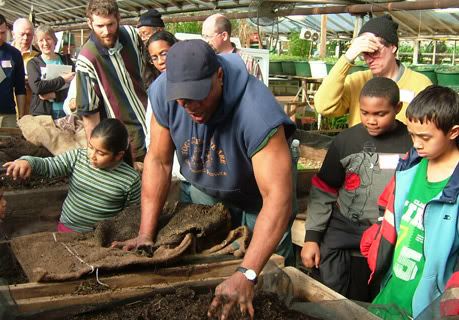
Yup, Will is a doer. He grows food where you would least expect it, using earthworm poop to maximize soil quality, food scraps and paper products for compost, hoop houses to grow crops out of season, and aquaponics to grow over a 100,000 fish indoors.

A genius, indeed.

While I was at the Grass Valley Food and Farm Conference a few weeks ago, I not only got to introduce Will to the attendees but I got to sit down with him and pick his big brain for a bit.

Definitely one of the highlights of my life.

Click below to get to know more about Will Allen. The man is amazing.

Enjoy,

Sean
Author, The Dark Side of Fat Loss
Dark Side of Fat Loss

From Slavery to Sharecropping to Solutions (Part 2 of 2)

October 4th, 2012

by Sean Croxton

Click HERE for Part 1.

It went well.

Last Saturday, I had the privilege of presenting at the Black Male Empowerment Summit at Georgia Southern University (GSU). In the hours leading up to the first of my two talks, I wondered if these young men (and a few women) would even be interested in listening to me babble about holistic health and wellness for an hour. Turns out they were.

They raised their hands and asked great questions.

They shared their own experiences.

They expressed their frustrations with the limited access to healthy food.

These young people really cared.

Despite their interest in the topic, I wondered if I had really made an impact — would any of my attendees actually put the information to use?

Then this week, while I read Will Allen’s book The Good Food Revolution for the second time, I came across a passage regarding a recent study of one hundred sixth-graders who had participated in a hands-on, garden-based nutrition education program. Allen writes,

“(These students were compared) with two other groups: students who were taught nutrition lessons in a classroom and those who were given no nutrition education at all. The researchers found no significant difference a year later in the vegetable and fruit consumption of children without nutrition education and those who received nutrition classes. The students who received hands-on training in a garden, however, increased their fruit and vegetable intake by more than two servings a day.” (Allen, 160-161)

No, I don’t typically work with sixth-graders (then again, maybe I should), but I can’t help but wonder…

Does the power of the real food message reside in the information alone, or is the most powerful impact sparked by a real life physical connection with the soil and where our food comes from?

Is spending a day on a farm infinitely times more transformative than reading a book or a blog?

Will Allen seems to think so, and I tend to agree with him. The urban agriculturalist writes, “My own experience tells me that if we can expose young people to more fresh, delicious food — and create positive emotions around those experiences — that we can increase the chances that they will adopt more fresh food into their diet as they begin to make independent food choices later in life.”

But this begs another question…

In the Black community — or any other neighborhood where healthful food is scarce — where does one go to come into contact with these fresh, delicious foods, and to experience these positive emotions?

In these communities, food is seldom associated with soil but with drive-thru windows and cellophane packaging. Instead of food being the source of positive emotions (and thus healthful choices), food companies link their health-less products to the consumer’s positive emotions for Kobe Bryant or LeBron James. It’s actually quite brilliant.

What is even more brilliant is what Will Allen is doing to bring agriculture back to the inner city. Each year, Will and his Growing Power team — located in Milwaukee, WI — produce 40 tons of vegetables and raise 100,000 fish on just three acres of land, and in an urban area where soil quality is typically poor due to the lack of animal life and organic matter.

Even more amazing than the immensity of Mr. Allen’s food production is the effect his organization has had on the surrounding community, where disinvestment has led to an exodus of supermarkets and an influx of fast food joints and corner stores.

Growing Power is a place where visitors can literally reconnect with their roots. People of all races can dig their hands deep into the soil and feel where real food comes from. African-American men, women, boys, and girls can recapture the generational wisdom of growing and cooking their own food. The shameful emotions of slavery and sharecropping are replaced by a brand new enthusiasm for self-sufficiency and community.

I can’t stop wondering…

What if those students attending my presentation knew how to use earthworms to turn waste — discarded vegetables and fruits, meat scraps, coffee grounds, and paper products — into the most incomparable fertilizer?

What if they knew how to create an inexpensive system for growing fish while at the same time raising plants by using their roots to clear toxic nitrogen from the water before returning it to the fish via gravity?

What if they had spent just a few days of their youths preparing affordable fruit and vegetable baskets for impoverished families?

What if they had, just once, risen at 4am to harvest organic asparagus, collards, spinach, and carrots, and taken them to market the following day to earn income through nourishing the bodies of their neighbors?

If they had had these exposures and experienced the accompanying emotions…

Would they still consume junk food, order meals through a talking menu board, or give two sh*ts about what LeBron and Kobe have to say about anything other than basketball?

Would they need me to fly across the country to tell them what real food is?

Probably not.

At the conclusion of each of my sessions, I challenged the students to be the ones who change the health of future generations of African-Americans. Empowering health habits are just as easy to pass down generationally as poor ones. Be the change.

The world needs more Will Allens. He exemplifies the change more than anyone I have ever come across. His story has inspired the heck out of me. I suggest you read The Good Food Revolution. At the very least, watch the video below to learn more.

Underground Gardens has a nice ring to it.

Hmmmmm….

Sean
iJERF (Just Eat Real Food)
Real Food Summit

From Slavery to Sharecropping to Sickness. (Part 1 of 2)

September 27th, 2012

by Sean Croxton

I’m actually a bit embarrassed about this one.

Tomorrow morning I’ll be hopping on a bird and flying to the great State of Georgia to speak at the Black Male Empowerment Summit at Georgia Southern University.

My presentation, entitled How to Survive College with Your Health Intact, will offer these young men simple tips and strategies for avoiding the typical health challenges — weight gain, depression, blood sugar dysregulation, and more — that students often encounter by the time they make that final walk across the stage.

But that’s not what I’m embarrassed about.

What’s had me feeling a bit ashamed over these past couple weeks, as I’ve prepared for my talk, is my complete disconnection with the history of agriculture and its impact on the Black community.

It’s been 25 years since I moved from Oakland, CA, where my neighbors and classmates were pretty much all of color, to nearby Alameda, a predominantly White community where I was one of only three Black kids in the entire school.

I’ll never forget the first day of fourth grade at Saint Philip Neri Elementary School. I sat in Mom’s Volvo station wagon crying my eyes out as I looked out into the playground trying to find a single Black face. Talk about culture shock!

Alameda is where I would call home until I left to attend San Diego State University in 1995. I probably don’t have to tell you the demographics there.

By no means are my memories of living in a Black community ones of poverty or hardship. My father was one of the best shoe salesmen Macy’s had ever seen. Mom worked for the phone company.

We lived in a two-story house with a well-kept lawn and a tall palm tree in the front yard. My brother and I had a room dedicated to toys — The Toy Room, we called it — and a swing set and basketball court out back.

Every night, we sat around the kitchen table, talked, and ate Mom’s home-cooked meals. I can even vaguely remember Mom (then again, maybe it was Dad) growing strawberries, tomatoes, and lemons in the backyard. But the vivid memories of spending many Saturdays on my hands and knees pulling weeds will never leave me.

I hated pulling weeds.

Soon after my parents divorced, Dad hit the road and never looked back. My brother and I were two young Black kids being raised by a Mexican mother in a White community. We were mixed up, both literally and ethnically.

As I grew older, I became well aware of the fact that I was missing out on Black culture. In an attempt to make up for it, I read books like The Autobiography of Malcolm X, Soul on Ice, and Manchild in the Promised Land. I can tell you all about the Black Panthers, Fred Hamptom, and the FBI’s programs to destroy the reputations of black leaders (and more).

But one thing I couldn’t tell you about is the connection between agriculture and the current state of the black community. It never clicked. That is, until now.

I have Will Allen — an urban farmer based in Milwaukee, WI — and his book The Good Food Revolution to thank for that.

——————————-

What’s Race Got to Do With It?

I’m sure many of my readers are wondering what race has to do with it. We live in a time when a Black family lives in the White House. Haven’t we moved beyond race?

In some ways we have, and in others we have not. Yes, we have come a long way in terms of race relations, but all is not well and not everyone is healthy.

Although we as Americans have a right to choose, many of us are running low on options, especially when it comes to our food supply. This fact is no more evident than within this nation’s Black communities where it is easier and much cheaper to purchase a Hostess apple pie than an actual apple, where the closest supermarket is 20 minutes away but the convenience store is on the next corner, and where the food is almost always fast.

In his book Will Allen quotes his good friend Sharon Adams as saying, “Any time you live in an area where you don’t have healthy choices, you don’t have a healthy community.”

Modern disease has run rampant amongst all races, but lack of healthy choices has hit the Black community hardest of them all. It is said that one in every two Black babies born in the year 2000 will be diagnosed with diabetes at some point in his or her life. The odds are 1 in 3 for babies of all other races. Four out of ten Black men and women over the age of twenty have high blood pressure. And Blacks are thirty-percent more likely to die young from heart disease than Whites. (Allen, 7)

Race has a lot do with it.

Lack of access to healthy food has a lot do with it.

Unfortunately, not much is being done about it.

—————————–

The Great Migration

What never quite struck me until now is that it has only been 3-4 generations since Blacks were agriculturalists. Our ancestors worked in the fields where they grew and harvested asparagus, collards, parsnips, watermelon, and more. Not only did they grow these foods, but they also knew how to prepare them. Farming and cooking techniques were passed down through the generations. Through their knowledge and experience with managing soil and thus the production and preparation of nutritious foods, Black men and women were able to maintain their physical health.

And then it stopped.

This country’s agricultural system was built on the blood, sweat, and tears of Black slaves and sharecroppers. With the Emancipation Proclamation came uncertainty amongst the freed slaves. Allen writes, “…some were said to have walked to the entrance of their plantations only to turn directly around and come back.”

Many of these freed slaves became sharecroppers, entering into agreements with their former owners. These agreements allowed the sharecropper to use the landowner’s farm and tools to grow crops. At the end of each growing season, the landowner would take the crops to market and split the proceeds with the sharecropper.

In theory the sharecropping system seems far more appealing than slavery. However, sharecroppers often had to borrow money from their landowners at the beginning of each growing season. Once the harvested crops were eventually sold at market, there was little, if anything, left of the sharecropper’s split. Season after season, many found themselves in worse debt than when they started.

The breaking point occurred when the Great Depression drove crop prices way down. Sharecropping was no longer worth the trouble. Southern Blacks packed their bags and hopped aboard segregated trains to the North in hope of new opportunities.

It is said that over six million men and women took part in The Black Migration. Most simply wanted to put the hardships of slavery and sharecropping behind them. In so doing, a long history of self-sufficiency and survival through agriculture was lost. Life on the plantation was, for many, a source of shame. Gone was the pride of living off the land. Thus began a community’s dependence on a food system that reflects everything that has gone wrong with agriculture since.

—————-

Stay tuned for Part 2 next week. We’ll discuss how Will Allen has brought agriculture back into the inner cities. It’s an inspiring story.

Hate to leave you hanging, but I have to get ready for tonight’s FREE webinar on adrenal dysfunction. It’s at 5pm PT/8pm ET. If you haven’t registered click HERE! Or come back to this blog Monday to watch the recording.

Out.

Sean Croxton
Author, The Dark Side of Fat Loss
Dark Side of Fat Loss